


 Résultat de la recherche : 'with'
BACQUART Jean-Baptiste
The Tribal Arts of Africa: Surveying Africa's Artistic Geography
Détails sur le produit: ISBN 10: 0500282315 / 0-500-28231-5 / ISBN 13: 9780500282311 - Casa editrice: Thames & Hudson - Data di pubblicazione: 2002 - Legatura: Brossura - Pagine:240
Descrizione libro:
Thames Hudson Ltd, United Kingdom, 2002. Paperback. New edition. 305 x 225 mm. Brand New Book with Free Worldwide Delivery. This work displays and defines the fruits of thousands of years of black African creative endeavour. All the objects included were made by Africans for their own use, spanning a period from the beginning of the first millennium to the early 20th century, before the commercial production of art aimed at the tourist trade. Jean-Baptiste Bacquart, has divided Africa south of the Sahara into 49 cultural areas. Each section studies the most important tribe within the area, surveying its social and political structures as well as its artistic production. The art is analyzed according to type - in most instances masks, statues, and everyday objects, such as utensils, furniture and jewelry. Where appropriate, further information on artistically related tribes is then provided. Each section contains its own bibliography. A detailed reference section with information on key collectors, collections open to the public and a glossary completes this
[ Lire la suite... ]
|
Full text, digitalised by Lies Strijker and presented by the .Centre Aequatoria
Notes on the digitalisation and presentation
[Cover]
[1: empty]
[2]
IMPRIMI POTEST
Kanzenze, 12-2-1952
P. Simeon, o.m.f.
Sup. Reg.
IMPRIMATUR
Luabo-Kamina, 30-5-1952
+VICTOR PETRUS KEUPPENS
Vic. Ap. de Lulua
[3]
BANTU PHILOSOPHY
by
The Revd. Father PLACIDE TEMPELS
(Translated into English from "La Philosophie Bantoue" the French Version by Dr. A. Rubbens of Fr. Tempels' original work. The Revd. Colin King, M.A. Translator.)
With a Foreword to the English Edition by Dr Margaret Read, C.B.E.Ph. D.,M.A., formerly Professor of Education and Head of the Department Of Education in Tropical Areas, The
[ Lire la suite... ]
|
WHAT IS AFRICAN ART?
SUPPORT NOTES FOR TEACHER
Learning & Information Department
Telephone +44 (0)20 7323 8511/8854
Facsimile +44 (0)20 7323 8855
education@thebritishmuseum.ac.uk
Great Russell Street
London WC1B 3DG
Switchboard +44 (0)20 7323 8000
www.thebritishmuseum.ac.uk
Commemorative head of a Queen Mother
[ Lire la suite... ]
|
THE NEW CONGO COLLECTION
During the summer of 1912 the Museum acquired by purchase a collection of about two thousand
specimens consisting of weapons, utensils, ornaments, clothing and images from a number of African
tribes living in the Congo basin. This collection was, for the most part, obtained from the natives by the
well-known German traveler, Frobenius.
in a way which served at least to show what a variety of artistic activities and what a rich culture the in
a way which served at least to show what a variety of artistic activities and what a rich culture the
native Congo peoples possess.
native Congo peoples possess.
Visitors had an opportunity of admiring the wonderful carved wooden boxes and |
[ Lire la suite... ]
|
|
|
Tribal Art - Jean-Baptiste BacquaLire la suite... ]
|
Walker Evans
Walker Evans
Il est né le 3 novembre 1903, à Saint-Louis, Missouri. Il étudie au Williams College en 1922-1923 et à la Sorbonne en 1926. Evans débute la photographie en 1930. Il obtient une bourse de la Fondation John-Simon-Guggenheim en 1940, 1941 et 1959. Il entre au magazine Time en 1945 et à Fortune en 1965. Cette même année, il devient professeur de photographie à l'école d'art de l'Université Yale. Il est mort le 10 avril 1975, à New Haven, Connecticut.
On connaît notamment son travail sur la Grande dépression, participant au programme de la Farm Security Administration. Les images de métayers dans l'Alabama, au même titre que celles de Dorothea Lange, comptent parmi les icônes du monde moderne.
On remarque dans son travail les regards des sujets fixant l'objectif de Walker Evans : ici pas de doute le sujet se sait photographié, pour autant il ne se compose pas un visage de circonstance orné d'un sourire obligatoire. Ici la photographie ne se contente pas de montrer, elle interroge le spectateur, l'américain des années 1930 : si le sujet se laisse photographier dans cette posture, c'est que son regard a quelque chose à nous dire. Ce n'est peut-être plus nous qui le regardons mais lui qui nous accuse.
Cette franchise du photographe préserve une dignité humaine mise à mal par la misère qui se laisse voir dans les vêtements en loques.
Cet aspect de ses photos est
[ Lire la suite... ]
|
a
by Peter Walsh
"MEMORY: Luba Art and the Making of History," one of the largest and most important exhibitions of African art ever to appear in the Boston area, will be on view at the Davis Museum and Cultural Center from February 5 through June 7, 1998. Organized by The Museum for African Art in New York City, this critically acclaimed exhibition of exceptionally beautiful artworks explores for the first time in an American museum exhibition the intricate and fascinating culture of the Luba of the Democratic Republic of the Congo (formerly Zaire). More than 80 important and beautiful objects are included in the show.
Since it opened in New York City in February 1996, MEMORY has received enormous popular and critical praise. The New York Times described it as "everything an exhibition ought to be. Visually riveting and built on a theme as philosophically complex as it is poetic, it has the pace and pull of an unfolding epic... MEMORY... brings to vivid life an art that is both a wonder of formal invention... and a sovereign vehicle for profound ideas."
MEMORY will include standing figures, staffs of office, ceremonial weapons, masks, divining tools and amulets as well as fine examples of lukasas, or Luba "memory boards," all of which the Luba used as elaborate visual symbols to record their cultural memories, histories, traditions, and royal lineages. The show and its accompanying catalogue are the culmination of a decade of intense and path-breaking research and study
[ Lire la suite... ]
|
Art primitif : prix du désir, prix de l’objet
AuteurRolande Bonnain-Dulon du même auteur
CRH/EHESS
24, bd de Magenta
75010 ParisRolande.Bonnain-Dulon@ehess.fr
« L’art primitif a influencé tout l’art contemporain.
C’est normal qu’il ait un prix. »(Jeune marchand parisien)
« Noirs désirs » [Télérama, 26/06/2003], « Bas les masques » [Libération, 1/07/2001], « La ruée vers l’or noir » [Le Figaro, 2/07/2001], « Les sortilèges de l’art africain » [Le Figaro, dossier Patrimoine, 26/10/2001], tous ces titres (et d’autres non moins accrocheurs) ont annoncé et suivi la dispersion aux enchères publiques en juillet 2001, soit un an après sa mort, de la collection d’art primitif d’Hubert Goldet, grand amateur et cofondateur de la revue ArtPress. La vente, qui avait duré deux jours et attiré amateurs, marchands et curieux d’Europe et d’Amérique, avait joui d’un énorme succès : 644 lots proposés et vendus pour la somme de 88,4 millions de francs avec les frais soit 13,5 millions d’euros. Cet événement témoigne, s’il en est encore besoin, que ce domaine de l’art, l’un des derniers découverts par l’Occident, n’est plus confidentiel et déborde le cadre du petit monde des initiés. Depuis son ouverture en avril 2000, le pavillon des
[ Lire la suite... ]
|
The Sejen bird figures of the Senufo People, Ivory Coast
The art of the Senufo people is quite popular nowadays, and their sculpture and masks are found in many European and American collections. There are about 3 million Senufo living in the north of the Ivory Coast and the southern area of Mali. As in every country that was in touch with Islam and Christianity, many aspects of the traditional "native" culture were destroyed, especially in the 1950's where a new syncretic movment, "Massa or Alkora", was in the area. There has been much French ethnologic field researchin that region. Those pioneers had their own methods of acquiring pieces (that's another story).
|
Enchères et émotions
AuteurRolande Bonnain-Dulon du même auteur
École des hautes études en sciences sociales
EHESS
Centre de recherches historiques
54, bd Raspail
75006 Paris
Au-delà de leur public bien sûr, les ventes aux enchères passionnent les sociologues et les ethnologues et ce, à juste titre [Matras-Guin, 1987 ; Quémin, 1993 ; Rémy 1990]. Grâce à eux, on a compris pourquoi cette pratique sociale qui mêle l’économique au symbolique, le rationnel aux émotions, l’individuel à une certaine forme de collectif attire tant de gens qui vont là comme au spectacle, par curiosité, sans avoir toujours l’intention de participer aux enchères. Ces chercheurs nous ont également montré le rôle que ces lieux ont joué sur la constitution des communautés diffuses et temporaires, la mise en place de rituels profanes, le vécu de la concurrence, le rapport aux objets, le métier de commissaire-priseur.
2 Avec cet article, nous visons à montrer la forte incidence du lieu et les effets de sa représentation sur l’existence, les pratiques et les particularités d’un certain monde[1] [1] On utilise ici le terme « monde » dans le sens que lui...
suite, celui des collectionneurs d’arts premiers[2] [2] L’expression « arts premiers » désigne ici, sans...
suite dont les objets acquièrent lentement le statut d’art classé, en particulier en ces temps où le Louvre les accueille.
3 Aujourd’hui, les anciennes puissances coloniales ne se livrant plus à des guerres de conquête, une pièce classée dans les arts premiers n’a guère
[ Lire la suite... ]
|
Africa, Oceania and the Indigenous Americas | |
The Department oversees four separate collection segments: the arts of
Africa, Egypt, the South Pacific and the Indigenous Americas.
Reflecting current scholarship and geography, Egyptian art is now a
sub-section of this department. African art thus consists of works from
the rest of Africa other than Egypt.
 African ArtThe
DIA’s African art collection ranks among the finest in the United
States. It comprises some rare world-class works from nearly one
hundred African cultures, predominantly from regions south of the
Sahara desert. A diverse collection, ranging from sculpture to textiles
to exquisite utilitarian wares, religious paraphernalia and bodily
ornaments, it is heavily weighted toward the nineteenth and twentieth
centuries. African art collecting is
inextricably tied to the founding of the Detroit Institute of Arts at
the turn of 20th century and remains one of the institution’s important
hallmarks. From the late 1800s through the 1930s, generous
contributions from some of Detroit’s first collectors, such as
Frederick Stearns and Robert Tannahill, helped to develop the core
collection. This included priceless works, such as several Benin royal
brass sculptures, an exquisite 16th century Kongo Afro-Portuguese ivory
knife container, a 17th century Owo ivory bracelet, a Kongo steatite
funerary figure (ntadi) and a finely crafted Asante royal gold
soul-washer’s badge recovered from the chamber of the nineteenth
century Asante King, Kofi Karikari. Support from the City of Detroit
has since aided the purchase of additional works of |
[ Lire la suite... ]
|
|
Masks
The viewing of masks is often restricted to certain peoples or places,
even when used in performance, or masquerade. African masks manifest
spirits of ancestors or nature as well as characters that are spiritual
and social forces. During a masquerade, which is performed during
ceremonial occasions such as agricultural, initiation, leadership and
funerary rites, the mask becomes the otherworld being. When collected
by Western cultures, masks are often displayed without their costume
ensemble and lack the words, music and movement, or dance, that are
integral to the context of African masquerades.
Visually, masks are often a combination of human and animal traits.
They can be made of wood, natural or man-made fibers, cloth and animal
skin. Masks are usually worn with costumes and can, to some extent, be
categorized by form, which includes face masks, crest masks, cap masks,
helmet masks, shoulder masks, and fiber and body masks. Maskettes,
which are shaped like masks, are smaller and are not worn on or over
the face. They may be worn on an individual’s arm or hip or hung on a
fence or other structure near the performance area.
Sculpture
The cultures of Africa have created a world-renowned tradition of
three-dimensional and relief sculpture. Everyday and ceremonial works
of great delicacy and surface detail are fashioned by artists using
carving, modeling, smithing and casting techniques. Masks, figures,
musical instruments, containers, furniture, tools and equipment are all
part of the sculptor’s repertoire.
The human figure is perhaps the most prominent sculptural form in
Africa, as it has been for millennia. Male and female images in wood,
ivory, bone, stone, earth, fired clay, iron and copper alloy embody
cultural values, depict the ideal and represent spirits, ancestors and
deities. Used in a broad range of contexts--initiation, healing,
divination,
[ Lire la suite... ]
|
Throughout
the centuries, African artists have created artworks in various media
that underscore the dynamic quality of Africa's visual traditions.
The categories presented here represent the breadth of the collection
and are intended as a guide. The
NMAfA collection includes tradition-based and contemporary
works of art. Both address important issues of identity, history
and aesthetics, demonstrate dynamism and reflect change as African
artists respond to new ideas, materials and sources of inspiration.
Tradition-based arts
help shape and reflect established formal, functional and aesthetic
canons. These artworks, which are used in everyday and ceremonial
settings, address individual and community needs and serve social,
religious and political ends. Humans and animals, the primary subjects
in African art, depict desirable and undesirable aspects of human
behavior. Deities, ancestors and other spiritual beings that are
portrayed embody the breadth of African religious beliefs and practices. The creators of tradition-based
African art are known and respected members of their communities.
Unfortunately, those who created many of the exquisite works now
found in museum collections remain unknown because their names were
not recorded when the objects were collected many decades ago. In
[ Lire la suite... ]
|
Artful Animals
July 1, 2009--February 21, 2010
Artful Animals, an exhibition dedicated to
young audiences, explores how African artists create striking works of
art using images from an array of domestic and untamed animals. From
rock art to contemporary painting, audiences will discover animals used
as symbols of royal arts, in masquerades for the ancestors and others
rarely seen. Many of the elements of design are derived through direct
observation of the animals in their natural habitat. It is the animal's
conduct and distinct behaviors that carry the messages in performances,
stories and proverbs. The approximately 125 works capture not only the
physical characteristics of animals but also the many ways that
animals, from spiders to leopards, act out our human shortcomings and
successes. Themes include notions of nurturing, power, wisdom,
transformation, beauty and aggression.
The National Museum of African Art is collaborating with Smithsonian
education units at the National Zoological Park, National Postal
Museum, National Museum of Natural History and Discovery Theater. Each
partner site will feature a host of multidisciplinary activities.
The programming project has been supported by the Smithsonian School Programming
[ Lire la suite... ]
|
|
At once beautiful, protective, seductive, and dangerous, the water
spirit Mami Wata (Mother Water) is celebrated throughout much of Africa
and the African Atlantic. A rich array of arts surrounds her, as well
as a host of other aquatic spirits--all honoring the essential, sacred
nature of water. Mami Wata is often portrayed as a mermaid, a snake
charmer, or a combination of both. She is widely believed to have
"overseas" origins, and her depictions have been profoundly influenced
by representations of ancient, indigenous African water spirits,
European mermaids, Hindu gods and goddesses, and Christian and Muslim
saints. She is not only sexy, jealous, and beguiling but also exists in
the plural, as the mami watas and papi watas who comprise part of the vast and uncountable "school" of African water spirits.
Mami Wata's presence is pervasive partly because she can bring good
fortune in the form of money. As a "capitalist" deity par excellence,
her persona developed between the fifteenth and twentieth centuries,
the era of growing trade between Africa and the rest of the world. Her
very name, which may be translated as "Mother Water," is pidgin
English, a language developed to facilitate trade. Countless enslaved
Africans forcibly brought to the Americas as part of this "trade"
carried with them their beliefs, practices, and arts honoring water
spirits such as Mami Wata. Reestablished, revisualized, and revitalized
in the African Atlantic, Mami Wata emerged in new communities and under
different guises, among them Lasirèn, Yemanja, Santa Marta la
Dominadora, and Oxum. African--based
[ Lire la suite... ]
|
Treasures marks the National Museum of African Art's 25th anniversary as a Smithsonian museum. The first in a new exhibition series, Treasuresis an old-fashioned show about African art, reminiscent of the
exhibitions that represented avant-garde opinions of the early 20th
century. In 1926, Paul Guillaume, Parisian connoisseur and collector,
cautioned readers to defer learning about the history and meaning of
African art until they had studied African art purely as an art form,
because to do otherwise "tends to obscure one's vision of the objects
as sculpture."I chose the familiar--traditional sculpture--to reveal aesthetic variances, to see African art as form, not function. Treasures,
therefore, is about visual exploration and aesthetic discovery. Our
understanding of African art is prescribed by what we see, and often,
what we see is based on works displayed in museums. So, "Treasures" is
just that--a sampling that gives us a peek into the realm of African
art. 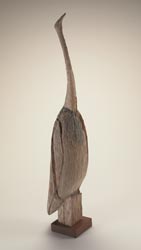 Westerners
and Africans alike revere well-made form. Each admires skillful
technique and execution, exquisitely rendered forms, pattern, balance,
symmetry, surface treatments and a sense of completeness. African
artists, however, strive to portray more than that. As metaphor or
symbol, their artworks embody the world of ideas and
beliefs--confirming their notions about themselves, life and death, the
universe and the spiritual realm. Yet, despite our cultural
presumptions that separate art from life, often separating aesthetics
from meaning, and our ignorance of or indifference to what it means and
how it is used, African art astonishes. An eclectic display of sculptures from East, West, Central, and southern Africa created between the 15th
[ Lire la suite... ]
|
|
|
|
|
|
|
|
|
|
|


