


 Résultat de la recherche : 'what'
The Authenticity of African Sculptures
by Henri Kamer
The issue of authenticity of African art has been central to collectors for decades. Henri Kamer, who was president of the International Arts Experts Association at the time, published an outstanding account of the state of the matter in Artes d'Afrique Noire, No. 12 (1974). The text that follows is extracted from an English translation of that article, and has been edited further. The original includes a number of illustrations. They are not included here because I believe the text suffices without them.
The original version, including the illustrations, in French and with the English translation, is
[ Lire la suite... ]
|
|escaper|escapen|escapetAfrican Art on the Internet |escaper|escapen |escaper|escapen|escapet |escaper|escapen |escaper|escapen|escapet |escaper|escapen |escaper|escapen|escapet |escaper|escapen |escaper|escapen|escapet15th Triennial Symposium on African Art, Arts Council of the African Studies Association, 2011, Wednesday, March 23 - Saturday, March 26, 2011, UCLA, Los Angeles, California |escaper|escapen |escaper|escapen|escapethttps://www.acasaonline.org/conf_next.htm |escaper|escapen |escaper|escapen|escapetAddis Art - Ethiopian Art and Artists Page |escaper|escapen |escaper|escapen|escapetContemporary Ethiopian art and artists - paintings, sculptures and digital art work by students and professionals from Addis Ababa, Ethiopia. University instructor, Getahun Assefa's paintings, drawings, sculpture, digital art. Also work by his brother, Tesfaye Assefa. Based in Addis Ababa, Ethiopia. [KF] https://www.addisart.com/ |escaper|escapen |escaper|escapen|escapetAddis Art - Nouveau Art from Ethiopia |escaper|escapen |escaper|escapen|escapetArtists include Shiferaw Girma and Lulseged Retta. Photographs of each artist's work, a biography, and video. Founded by Mesai Haileleul. [KF] https://www.addis-art.com/ |escaper|escapen |escaper|escapen|escapetAdire African Textiles - Duncan Clarke |escaper|escapen |escaper|escapen|escapetHistory, background, and photographs of adire, adinkra, kente, bogolan, Yoruba aso-oke, akwete, ewe, kuba, and nupe textiles. The symbolism of images is often provided. One can purchase textiles as well. Clarke's Ph.D. dissertation (School of Oriental and African Studies) is on Yoruba men's weaving. See also the Adire African Textiles blog. Based in London. https://www.adireafricantextiles.com/ |escaper|escapen |escaper|escapen|escapetAfewerk
[ Lire la suite... ]
|
JORDAN Manuel
Chokwe: Art and Initiation Among Chokwe and Related Peoples
Détails sur le produit: Broché: 191 pages Editeur: Prestel; Édition: illustrated edition (1 November 1998) Langue: Anglais - ISBN-10: 3791319973 - ISBN-13: 978-3791319971
Descrizione libro: Magnificently loaded with elegant plates of ceremonial and tribal objects from the Chokwe tribe and others in Angola, this exhibition catalog accompanies a show originating at the Birmingham Museum of Art in Alabama; editor Jordàn, who spent more than two years with the Chokwe and related tribes, is the museum's curator. The objects are mostly carved wood, but their polished, stylized vision of people and nature and the variety and especially the depth of feeling in masks raise them far above craft. The pieces are shown alone, as in a museum exhibit, with art stressed more than anthropology. To remedy this, seven scholarly articles by authorities on the Chokwe appear throughout, along with photos of native life. While this puts into context objects like whistles, thrones, and the intriguing divination baskets full of tiny magical charms, it has a somewhat choppy effect. One of a series of books on African art by Prestel (e.g., African Art from the Han Corey Collection, LJ 6/15/98), this covers a seldom-visited area rich in heritage. For larger art-oriented and college libraries.AGay W. Neale, Southside Virginia Community Coll. Lib.,
[ Lire la suite... ]
|
FARDON Richard and STELZIG Christine
Column to Volume: Pt. 1: Formal Innovation in Chamba Statuary
Détails sur le produit:
Relié: 160 pages - Editeur: Saffron Books (15 septembre 2005) - Collection: Saffron Afriscopes - Langue: Anglais - ISBN-10: 1872843468 - ISBN-13: 978-1872843469
FARDON Richard and STELZIG Christine:
Column to Volume: Pt. 1: Formal Innovation in Chamba Statuary
Descriptions du produit: Descrizione libro
Descriptions du produit:
Descrizione libro
Saffron Books [EAP London], 2005. Hardcover. 1st Edition. "Column to Volume: Formal Innovation in Chamba Statuary" investigates the appearance on world art markets during the 1970s of statues identified as Chamba from West Africa. Sought after for their artful execution, these statues were stylistically unlike anything previously documented from the region. Are they what the art market claimed? Who made them, when, where and why?To answer these questions, Richard Fardon and Christine Stelzig had to combine the findings of ethnographic research in Cameroon and Nigeria with museum and archival research and the testimonies of art dealers and collectors. Profusely illustrated, "Column to Volume" offers a comprehensive account of an important sculptural tradition in West Africa, as well as fascinating insights into the tribal branding, distribution, and copying, of African art works during the 1970s.Identifying formal innovation in what has been described as 'tribal' tradition, not least by tracing the individual sculptor irresponsible for
[ Lire la suite... ]
|
Full text, digitalised by Lies Strijker and presented by the .Centre Aequatoria
Notes on the digitalisation and presentation
[Cover]
[1: empty]
[2]
IMPRIMI POTEST
Kanzenze, 12-2-1952
P. Simeon, o.m.f.
Sup. Reg.
IMPRIMATUR
Luabo-Kamina, 30-5-1952
+VICTOR PETRUS KEUPPENS
Vic. Ap. de Lulua
[3]
BANTU PHILOSOPHY
by
The Revd. Father PLACIDE TEMPELS
(Translated into English from "La Philosophie Bantoue" the French Version by Dr. A. Rubbens of Fr. Tempels' original work. The Revd. Colin King, M.A. Translator.)
With a Foreword to the English Edition by Dr Margaret Read, C.B.E.Ph. D.,M.A., formerly Professor of Education and Head of the Department Of Education in Tropical Areas, The
[ Lire la suite... ]
|
WHAT IS AFRICAN ART?
SUPPORT NOTES FOR TEACHER
Learning & Information Department
Telephone +44 (0)20 7323 8511/8854
Facsimile +44 (0)20 7323 8855
education@thebritishmuseum.ac.uk
Great Russell Street
London WC1B 3DG
Switchboard +44 (0)20 7323 8000
www.thebritishmuseum.ac.uk
Commemorative head of a Queen Mother
[ Lire la suite... ]
|
THE NEW CONGO COLLECTION
During the summer of 1912 the Museum acquired by purchase a collection of about two thousand
specimens consisting of weapons, utensils, ornaments, clothing and images from a number of African
tribes living in the Congo basin. This collection was, for the most part, obtained from the natives by the
well-known German traveler, Frobenius.
in a way which served at least to show what a variety of artistic activities and what a rich culture the in
a way which served at least to show what a variety of artistic activities and what a rich culture the
native Congo peoples possess.
native Congo peoples possess.
Visitors had an opportunity of admiring the wonderful carved wooden boxes and |
[ Lire la suite... ]
|
Walker Evans
Walker Evans
Il est né le 3 novembre 1903, à Saint-Louis, Missouri. Il étudie au Williams College en 1922-1923 et à la Sorbonne en 1926. Evans débute la photographie en 1930. Il obtient une bourse de la Fondation John-Simon-Guggenheim en 1940, 1941 et 1959. Il entre au magazine Time en 1945 et à Fortune en 1965. Cette même année, il devient professeur de photographie à l'école d'art de l'Université Yale. Il est mort le 10 avril 1975, à New Haven, Connecticut.
On connaît notamment son travail sur la Grande dépression, participant au programme de la Farm Security Administration. Les images de métayers dans l'Alabama, au même titre que celles de Dorothea Lange, comptent parmi les icônes du monde moderne.
On remarque dans son travail les regards des sujets fixant l'objectif de Walker Evans : ici pas de doute le sujet se sait photographié, pour autant il ne se compose pas un visage de circonstance orné d'un sourire obligatoire. Ici la photographie ne se contente pas de montrer, elle interroge le spectateur, l'américain des années 1930 : si le sujet se laisse photographier dans cette posture, c'est que son regard a quelque chose à nous dire. Ce n'est peut-être plus nous qui le regardons mais lui qui nous accuse.
Cette franchise du photographe préserve une dignité humaine mise à mal par la misère qui se laisse voir dans les vêtements en loques.
Cet aspect de ses photos est
[ Lire la suite... ]
|
a
by Peter Walsh
"MEMORY: Luba Art and the Making of History," one of the largest and most important exhibitions of African art ever to appear in the Boston area, will be on view at the Davis Museum and Cultural Center from February 5 through June 7, 1998. Organized by The Museum for African Art in New York City, this critically acclaimed exhibition of exceptionally beautiful artworks explores for the first time in an American museum exhibition the intricate and fascinating culture of the Luba of the Democratic Republic of the Congo (formerly Zaire). More than 80 important and beautiful objects are included in the show.
Since it opened in New York City in February 1996, MEMORY has received enormous popular and critical praise. The New York Times described it as "everything an exhibition ought to be. Visually riveting and built on a theme as philosophically complex as it is poetic, it has the pace and pull of an unfolding epic... MEMORY... brings to vivid life an art that is both a wonder of formal invention... and a sovereign vehicle for profound ideas."
MEMORY will include standing figures, staffs of office, ceremonial weapons, masks, divining tools and amulets as well as fine examples of lukasas, or Luba "memory boards," all of which the Luba used as elaborate visual symbols to record their cultural memories, histories, traditions, and royal lineages. The show and its accompanying catalogue are the culmination of a decade of intense and path-breaking research and study
[ Lire la suite... ]
|
|
Masks
The viewing of masks is often restricted to certain peoples or places,
even when used in performance, or masquerade. African masks manifest
spirits of ancestors or nature as well as characters that are spiritual
and social forces. During a masquerade, which is performed during
ceremonial occasions such as agricultural, initiation, leadership and
funerary rites, the mask becomes the otherworld being. When collected
by Western cultures, masks are often displayed without their costume
ensemble and lack the words, music and movement, or dance, that are
integral to the context of African masquerades.
Visually, masks are often a combination of human and animal traits.
They can be made of wood, natural or man-made fibers, cloth and animal
skin. Masks are usually worn with costumes and can, to some extent, be
categorized by form, which includes face masks, crest masks, cap masks,
helmet masks, shoulder masks, and fiber and body masks. Maskettes,
which are shaped like masks, are smaller and are not worn on or over
the face. They may be worn on an individual’s arm or hip or hung on a
fence or other structure near the performance area.
Sculpture
The cultures of Africa have created a world-renowned tradition of
three-dimensional and relief sculpture. Everyday and ceremonial works
of great delicacy and surface detail are fashioned by artists using
carving, modeling, smithing and casting techniques. Masks, figures,
musical instruments, containers, furniture, tools and equipment are all
part of the sculptor’s repertoire.
The human figure is perhaps the most prominent sculptural form in
Africa, as it has been for millennia. Male and female images in wood,
ivory, bone, stone, earth, fired clay, iron and copper alloy embody
cultural values, depict the ideal and represent spirits, ancestors and
deities. Used in a broad range of contexts--initiation, healing,
divination,
[ Lire la suite... ]
|
Treasures marks the National Museum of African Art's 25th anniversary as a Smithsonian museum. The first in a new exhibition series, Treasuresis an old-fashioned show about African art, reminiscent of the
exhibitions that represented avant-garde opinions of the early 20th
century. In 1926, Paul Guillaume, Parisian connoisseur and collector,
cautioned readers to defer learning about the history and meaning of
African art until they had studied African art purely as an art form,
because to do otherwise "tends to obscure one's vision of the objects
as sculpture."I chose the familiar--traditional sculpture--to reveal aesthetic variances, to see African art as form, not function. Treasures,
therefore, is about visual exploration and aesthetic discovery. Our
understanding of African art is prescribed by what we see, and often,
what we see is based on works displayed in museums. So, "Treasures" is
just that--a sampling that gives us a peek into the realm of African
art. 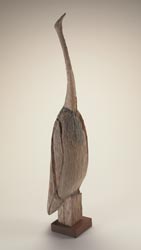 Westerners
and Africans alike revere well-made form. Each admires skillful
technique and execution, exquisitely rendered forms, pattern, balance,
symmetry, surface treatments and a sense of completeness. African
artists, however, strive to portray more than that. As metaphor or
symbol, their artworks embody the world of ideas and
beliefs--confirming their notions about themselves, life and death, the
universe and the spiritual realm. Yet, despite our cultural
presumptions that separate art from life, often separating aesthetics
from meaning, and our ignorance of or indifference to what it means and
how it is used, African art astonishes. An eclectic display of sculptures from East, West, Central, and southern Africa created between the 15th
[ Lire la suite... ]
|
|
|


